The Problem
Revenue cycle issues often start before the claim is ever created. Small gaps at intake can lead to big problems downstream.
What SignalDX Helps With
Pre-claim Issue Detection
Identify missing data, coding gaps, and potential claim risks early.
Billing Readiness Review
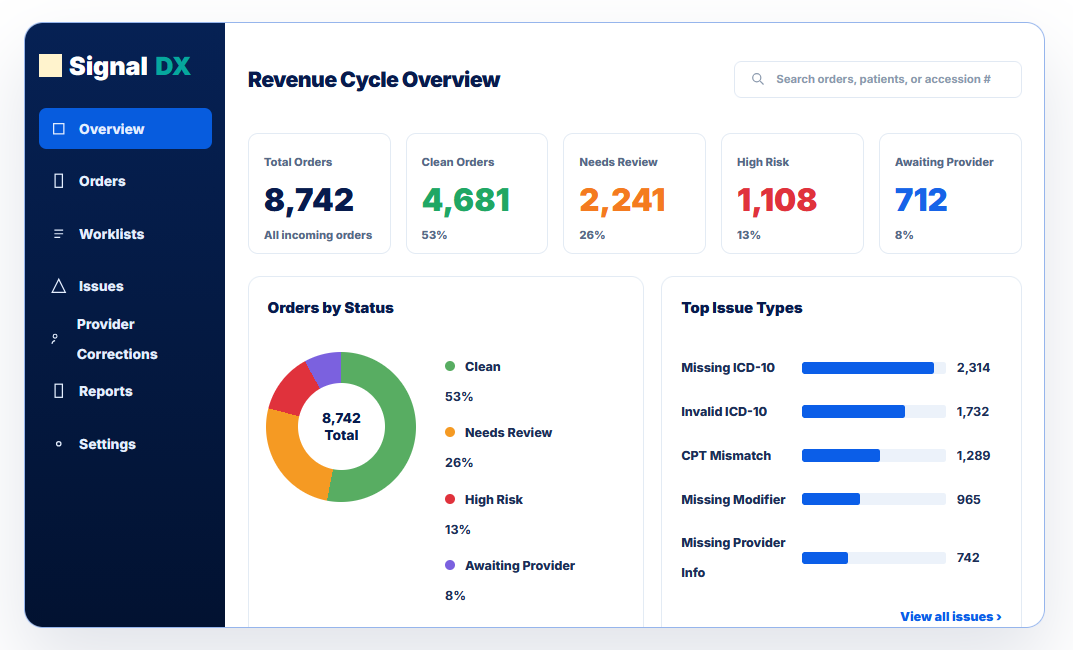
Classify orders so teams know what is clean, what needs review, and what is high risk.
Payer Policy Risk
Surface payer rules, medical necessity, coverage limitations, documentation needs, and prior auth indicators.
Correction & Audit History
Track every change, request, response, and resolution with a complete audit trail.
Example Revenue Cycle Checks
Missing, invalid, or non-specific ICD-10 codes
Test-to-CPT mismatch or missing coding logic
Missing, invalid, or potentially required modifiers
Missing NPI or incomplete ordering provider information
Medical necessity, coverage, or documentation concerns
Orders that may need authorization review
Missing patient, coverage, specimen, or order details
Whether the order is clean enough to move downstream
What was changed, reviewed, approved, and exported
A Cleaner Workflow for Revenue Cycle Teams
Order Enters SignalDX
Orders arrive from fax, HL7, portal, API, EHR, or manual intake.
SignalDX Structures the Order
Patient, provider, payer, test, diagnosis, CPT, and coverage details are extracted and normalized.
Issues Are Detected Early
Missing data, coding gaps, payer policy concerns, and billing-readiness risks are identified.
Teams Prioritize Work
High-risk and incomplete orders are routed into focused review queues.
Corrections Are Resolved
Staff manage provider follow-up, internal review, documentation requests, and issue resolution.
Clean Orders Move Downstream
Resolved orders are handed off to LIS, billing, clearinghouse, or RCM workflows.
Why Revenue Cycle Teams Use SignalDX
Order Intake
Downstream Systems
Built to Sit Before Billing, Not Replace It
SignalDX is not a billing system, clearinghouse, or RCM platform. It works upstream of those systems to help teams detect issues earlier, prepare cleaner order data, and reduce preventable downstream friction.