Policy Intelligence

Understand Payer Policy Before Claims Are Submitted

SignalDX helps labs identify payer policy, medical necessity, and documentation risks before orders move downstream into billing.
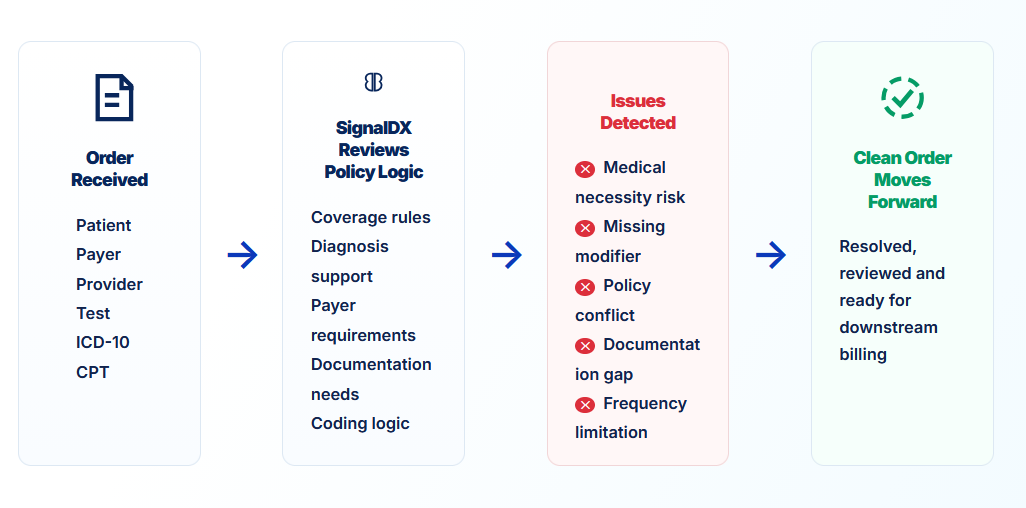
Detect policy conflicts early — including LCD/NCD issues, payer-specific rules, diagnosis-to-test mismatches, modifier requirements, and documentation gaps.

Why Policy Intelligence Matters

Payer rules are complex and constantly changing. SignalDX helps your team catch policy risk earlier in the order workflow — when it’s still easy to fix.

Diagnosis-Test
Mismatch

Diagnosis does not support the ordered test

Missing
Documentation

Required supporting documentation is not included

Payer-Specific
Rules

Requirements are overlooked or not fully understood

Modifier
Requirements

Modifier requirements are missed or invalid

Frequency
Rules

Frequency limitations are not checked early enough

What SignalDX Evaluates

SignalDX analyzes each order against the rules and requirements that can affect reimbursement.

Medical Necessity

  • Diagnosis-to-test relationships
  • ICD-10 support for ordered tests
  • Non-specific diagnosis codes
  • Coverage limitations

Payer Requirements

  • Payer-specific policy rules
  • Plan-level requirements
  • Documentation expectations
  • Prior authorization indicators

Coding Logic

  • CPT/test relationships
  • Modifier requirements
  • Place of service alignment
  • Test panel conflicts

Coverage Policy

  • LCD/NCD risks
  • Frequency limitations
  • Age or gender conflicts
  • Specialty testing considerations

Explainable Issue Detection

SignalDX doesn’t just flag issues — it explains why they matter and how to resolve them.

▲ Medical Necessity RiskHigh Risk
TestBRCA1/2 Analysis
ICD-10Z13.71 (Encounter for screening)
PayerAetna
Policy SourceAetna Clinical Policy: Genetic Testing - CP1234
ReasonDiagnosis does not meet medical necessity criteria for this test
Suggested ActionUpdate diagnosis code or provide additional clinical documentation
StatusNeeds Review

Assigned ToReview Team

Detected05/16/2024View Details ›

Before / After SignalDX

See the difference AI-powered policy intelligence makes.

Before SignalDX

Staff manually check payer rules
Policy issues are found late
Review varies by team member
Documentation gaps delay billing
Denial risk is hard to prioritize

After SignalDX

Policy risks detected upstream
Issues explained clearly
Orders prioritized by risk
Suggested actions guide review
Cleaner orders move downstream

Example Policy Issues SignalDX Can Surface

Medical Necessity Risk

The diagnosis code may not support the ordered test for the selected payer.

LCD/NCD Conflict

The order may not meet applicable coverage requirements.

Missing Documentation

The payer may require supporting documentation before billing.

Modifier Requirement

The test or billing scenario may require a specific modifier.

Frequency Limitation

The patient may have a policy-related frequency risk for the ordered test.

Diagnosis Specificity Issue

The ICD-10 code may be too general to support reimbursement.

Designed for Lab Review Teams

Turn complex policy rules into clear, actionable workflows.

Filter by
policy risk
See why the
issue was flagged
Assign and
collaborate
Request provider
corrections
Track status and
resolution
Send clean orders
downstream

Built for Complex Diagnostics

Supporting routine, specialty, and molecular testing workflows.

Molecular
Testing
Toxicology
Genetic
Testing
Specialty
Diagnostics
High-Volume
Labs
Payer-Specific
Rules

Why SignalDX Is Different

Policy Intelligence is more powerful when combined with the full platform.

Issue Detection

Detect policy risk early

Eligibility Verification

Validate coverage before billing

AI Fax Ingestion

Extract policy-relevant order details

Provider Corrections

Request missing or corrected information

Risk Scoring

Prioritize orders by reimbursement impact

Catch Policy Risk Before It Becomes a Denial

See how SignalDX helps diagnostic labs detect policy, medical necessity,
and documentation issues before claims are submitted.

Schedule a Demo