Why Integrations Matter
SignalDX fits into your existing lab workflow to catch problems before they impact billing and reimbursement.
What SignalDX Connects With
Intake Sources
- Fax
- Scanned PDFs
- Uploaded Documents
- HL7 Order Messages
- FHIR Resources
- API-Based Order Intake
Lab Systems
- LIS Platforms
- Accessioning Workflows
- Lab Operations Systems
- Test Catalog Data
- Provider Directories
- Payer Mappings
Revenue Systems
- RCM Platforms
- Billing Systems
- Clearinghouses
- Eligibility Vendors
- Claim Preparation Workflows
- Reporting Tools
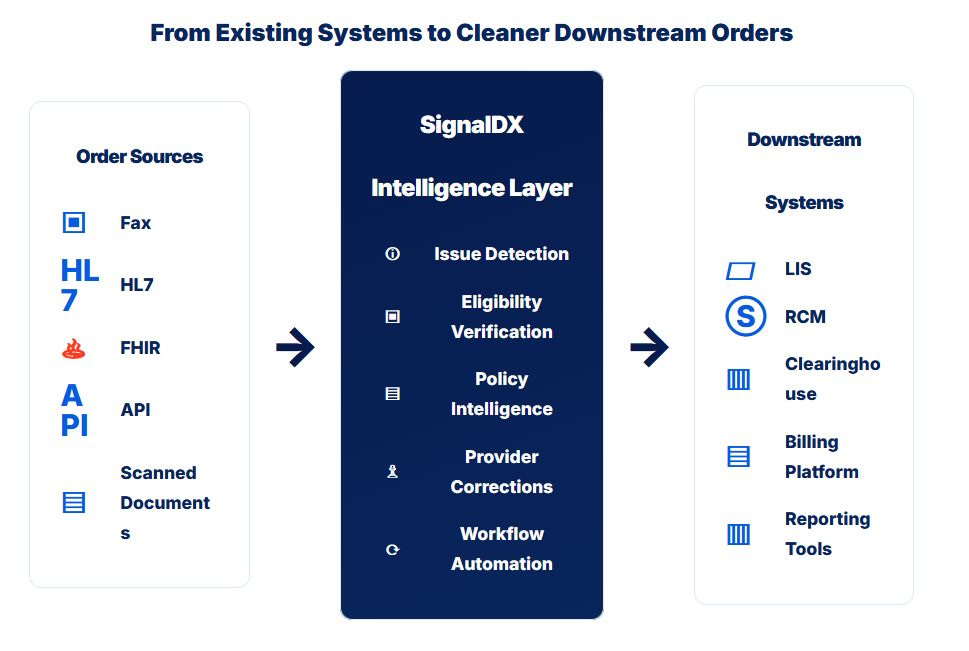
How SignalDX Fits: The Intelligence Layer Between Intake and Billing
Orders Enter SignalDX
Orders are received from fax, HL7, FHIR, APIs, documents, or existing systems.
SignalDX Structures the Data
Patient, provider, payer, test, ICD, CPT, modifier, and documentation details are normalized.
Issues Are Detected
SignalDX identifies missing data, eligibility issues, coding problems, and policy risks.
Teams Resolve Problems
Staff review issues, request provider corrections, update order details, and track status.
Clean Orders Move Downstream
Validated, structured order data flows into LIS, billing, RCM, or clearinghouse workflows.
Integration Types: Flexible Connection Options
Fax + Document Intake
Ingest and structure faxed requisitions, scanned PDFs, and supporting documents.
HL7
Accept HL7 order messages and return normalized updates or issue status outputs.
FHIR
Support modern healthcare data exchange for patient, coverage, provider, and orders.
APIs
Connect with internal systems, portals, billing workflows, and custom lab applications.
File-Based Exchange
Support batch workflows using structured exports where APIs are not available.
Before / After: Add Intelligence Without Replacing Your Systems
Before SignalDX
After SignalDX
Example Integration Workflows
Fax-to-LIS Review
Faxed requisitions are ingested, structured, reviewed, and then sent downstream as cleaner order data.
HL7 Order Review
Incoming HL7 orders are analyzed for missing fields, eligibility issues, and policy risks before billing.
Eligibility-Enhanced Intake
Extracted insurance details are used to run eligibility checks before the order moves forward.
Provider Correction Loop
Correction requests are generated from detected issues and attached back to the order record.
Clean Order Export
Resolved orders are exported into LIS, billing, RCM, or downstream operational workflows.
Data SignalDX Can Receive
- Patient demographics
- Insurance information
- Subscriber details
- Ordering provider information
- NPI and clinic details
- Ordered tests and panels
- ICD-10 codes
- CPT codes, Modifiers
- Place of service
- Clinical documentation
- Faxed requisitions and attachments
Data SignalDX Can Send Downstream
- Structured order data
- Normalized patient and payer details
- Detected issue status
- Correction history
- Eligibility results
- Policy review results
- Updated ICD/CPT/modifier details
- Supporting documentation
- Audit trail metadata
- Export-ready order records
Designed for Phased Implementation
Phase 1
Start with fax ingestion, issue detection, and review queues.
Phase 2
Add eligibility verification, provider corrections, and structured exports.
Phase 3
Connect deeper LIS, RCM, clearinghouse, and analytics workflows.
Get value quickly without waiting for a large integration project.
Works With the Full SignalDX Platform
- Issue Detection – Identify problems before downstream handoff
- AI Fax Ingestion – Structure paper-based intake
- Eligibility Verification – Validate coverage early
- Policy Intelligence – Detect payer and medical necessity risk
- Provider Corrections – Request and track missing information
- Workflow Automation – Route issues to the right team
Business Impact: Keep Your Systems. Add Upstream Intelligence.
- Reduce disconnected handoffs
- Improve order data quality
- Catch issues before billing
- Support cleaner downstream workflows
- Reduce manual re-entry
- Improve visibility across intake and billing
- Avoid rip-and-replace disruption
- Accelerate implementation value
Add Pre-Claim Intelligence to
Your Existing Lab Stack
See how SignalDX connects with your current intake, LIS, billing,
and RCM workflows to detect issues, support corrections,
and send cleaner orders downstream.